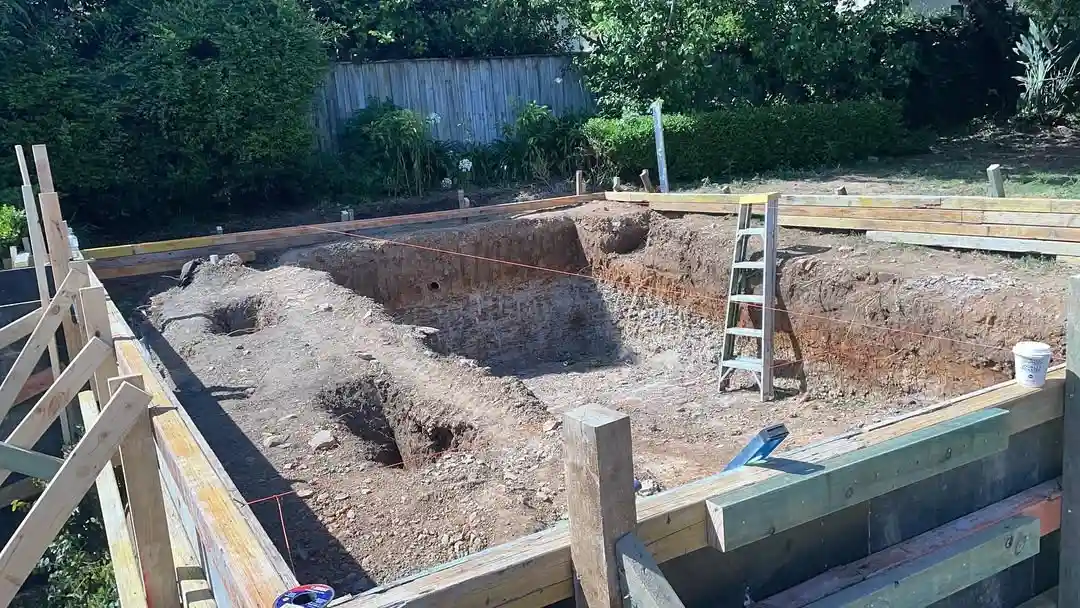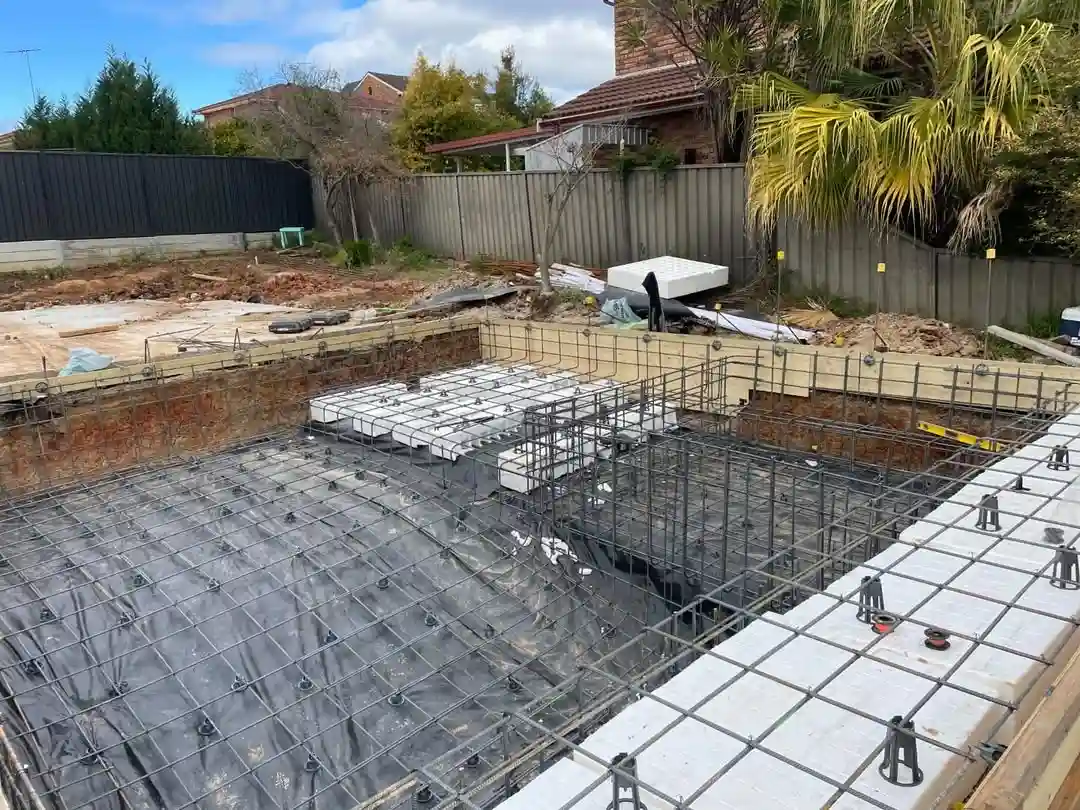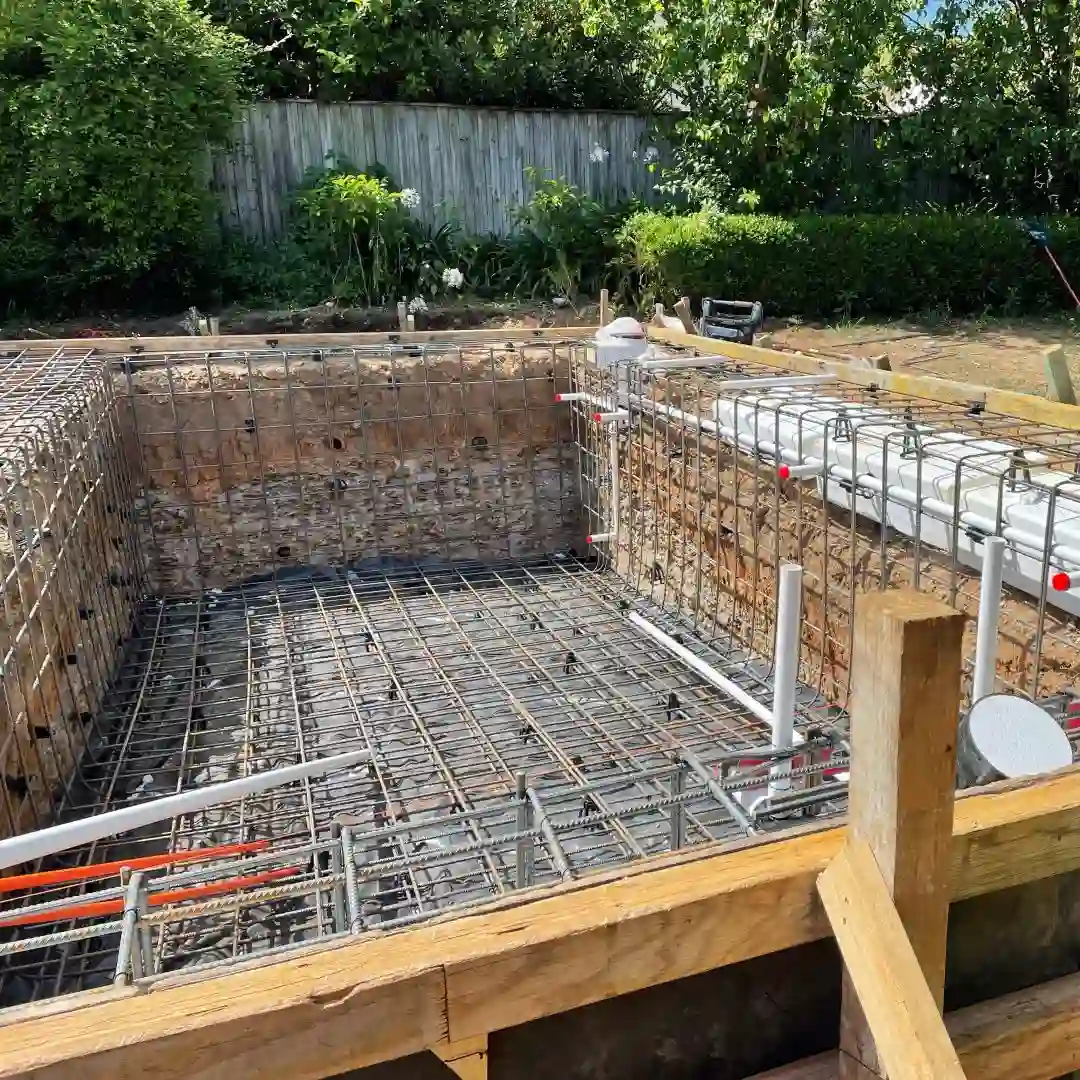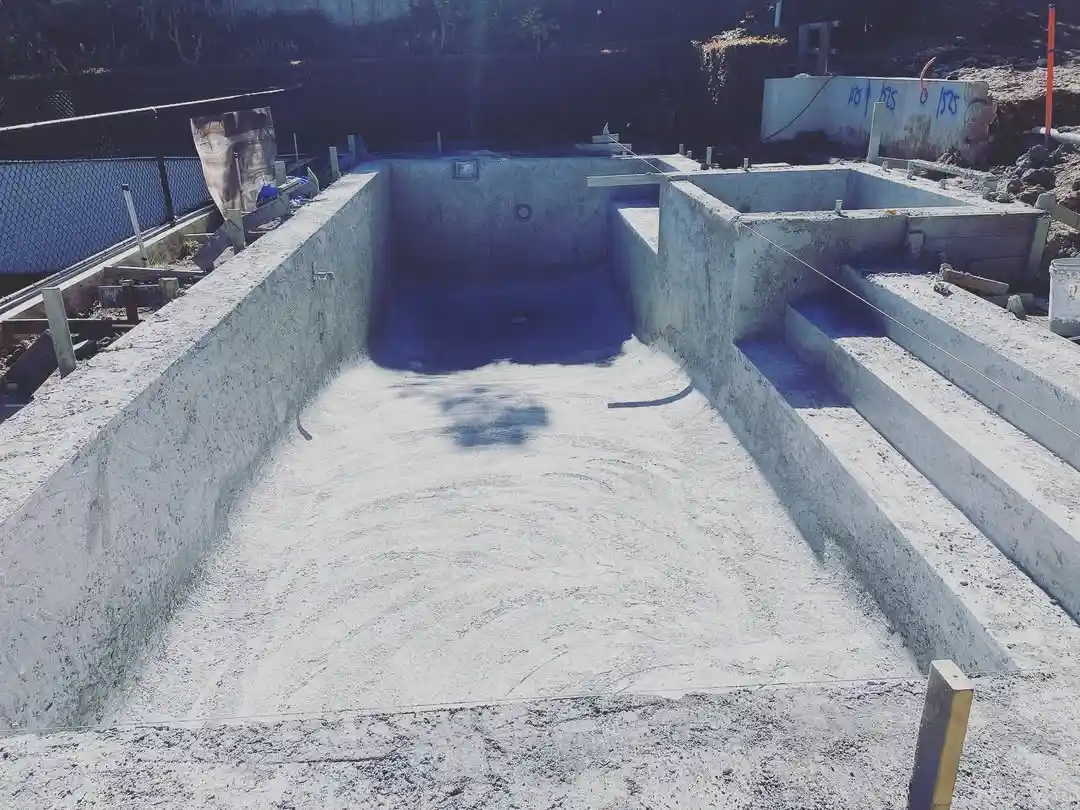
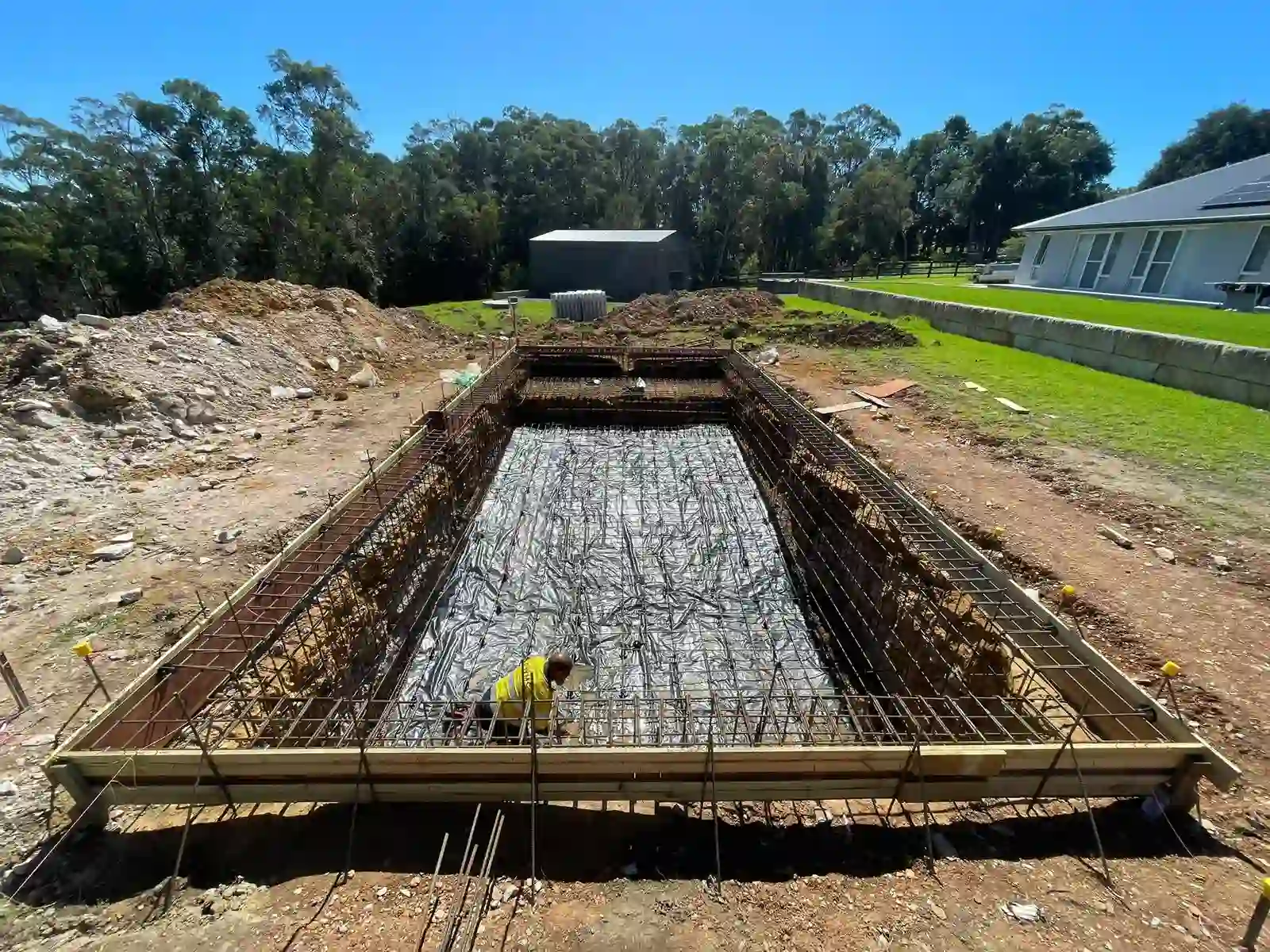
Once shotcrete is applied, every pipe in your pool is buried permanently. This is the stage where the right decisions — and the right crew — determine whether your pool runs flawlessly or becomes an expensive problem.
Most homeowners planning a concrete pool spend weeks choosing tiles, coping, and water features. Very few think carefully about pool plumbing rough-in in Sydney — the underground pipe network that gets installed between steel fixing and shotcrete. And yet this is the stage that, once complete, is literally locked inside concrete for the life of the pool.
At Sydney Pools Steel, pool plumbing rough-in is one of the four structural stages we specialise in — alongside pool excavation, steel fixing and formwork, and shotcrete. We install the underground pipe network, pressure-test every line, and hand over a fully verified rough-in that is ready for shotcrete application and later equipment connection by the principal builder’s trades.
This guide explains exactly what pool plumbing rough-in involves, why it must be done correctly before the shell is poured, and what to look for when this stage is underway on your build.
What Is Pool Plumbing Rough-In — and Why Does It Happen Before Shotcrete?
Rough-in plumbing refers to all underground pipe installation that occurs before the concrete pool shell is applied. In concrete pool construction, this means every pipe, every fitting, and every penetration point is set in position within the steel cage — and then shotcrete is sprayed over and around them, locking them permanently inside the shell.
This sequencing is non-negotiable. The pipes must go in after the steel cage is tied and inspected, and before a single metre of shotcrete is applied. Once the shell cures, there is no practical way to access, reroute, or repair a buried pipe without cutting through the concrete — an expensive and disruptive process that the right rough-in avoids entirely.
Why Sydney specifically matters: Sydney’s diverse soil conditions — from coastal sand on the Northern Beaches, to heavy clay through Penrith and the Hills District, to sandstone rock in the Eastern Suburbs — affect groundwater levels, pipe bedding requirements, and fall calculations. Pool plumbing rough-in in Sydney requires a crew that understands local ground behaviour, not just standard pipe installation technique.
To understand how the plumbing stage fits into the full build sequence, read our detailed guide on the concrete pool construction process in Sydney.
Pool Plumbing Rough-In in Sydney: Every Pipe Your Pool Needs Underground
A concrete pool plumbing system is not a single loop of pipe — it is a network of separate circuits, each with a specific function. Every one of these must be installed during rough-in, before the shell is poured.
| Pipe / Line | Function | Notes |
|---|---|---|
| Main drain lines | Draw water from the floor of the pool for circulation and filtration | AS 1926.3 requires dual main drains minimum, spaced correctly for anti-entrapment compliance |
| Skimmer lines | Draw water from the surface to remove debris before it sinks | Position is dictated by pool shape, prevailing wind direction, and the engineer’s design |
| Return jet lines | Return filtered water to the pool through wall inlets | Quantity, angle, and spacing set to engineer and hydraulic specifications |
| Vacuum / cleaner point | Dedicated connection point for automatic pool cleaners | Positioned to allow full pool coverage by the cleaner |
| Feature lines (if specified) | Water features, jets, bubblers, waterfalls | Must be installed at rough-in stage — cannot be added after shell cures |
| Equipment pad lines | Pipes that run from the pool to the external equipment pad (pump, filter) | Set to correct fall and pipe diameter — undersizing here causes pump cavitation |
Pipe Material and Diameter — Why Both Matter
All underground pool plumbing in Australia uses rigid PVC — typically 50mm or 63mm diameter depending on flow requirements. Flexible pipe is never used underground in pool construction; it collapses under soil pressure and can pull out of glued fittings over time.
Pipe diameter is a hydraulic decision, not a cost decision. A pipe that is one size too small forces the pump to work against resistance, causes noise and cavitation, increases energy consumption, and fails prematurely. Every pipe we install is sized to the hydraulic specifications of the pool design — not reduced to save materials cost.
Warning: A common cost-cutting move by inexperienced crews is to reduce pipe diameter or minimise the number of return lines. Both decisions save a few hundred dollars at rough-in and cost thousands in pump replacements, poor circulation, and algae problems over the pool’s lifetime.
Step 01
Verify the steel cage
Plumbing begins only after the steel reinforcement has been placed, tied, and checked against the engineer’s drawings. The cage must be complete and signed off before any pipes go in.
Step 02
Mark pipe positions
Every pipe penetration point — main drains, skimmers, returns, cleaner point — is marked to the engineer’s specifications before any cutting or installation begins.
Step 03
Install penetration sleeves
Plumbing begins only after the steel reinforcement has been placed, tied, and checked against the engineer’s drawings. The cage must be complete and signed off before any pipes go in.
Step 04
Run and secure all lines
Every pipe is cut to length, glued with appropriate PVC cement, set to the correct fall, and secured firmly so it cannot shift during shotcrete application. Movement at this stage creates permanent flow problems.
Step 05
Pressure test every line
Before shotcrete, every circuit is pressurised and monitored for leaks. A failed test means we find and fix the problem now — before it is buried in concrete forever.
Step 06
Cap and hand over
All lines are capped and clearly labelled at the equipment pad end. The rough-in is handed over ready for shotcrete — then later for equipment connection by the builder’s other trades.
Pressure Testing: The Non-Negotiable Step Before Shotcrete
Pressure testing is the most important quality control step in pool rough-in plumbing. A pipe joint that fails under test costs minutes to fix before shotcrete. The same joint discovered after the shell is poured requires concrete cutting, excavation, pipe replacement, and re-shotcreting — a process that costs thousands and disrupts the entire project.
We pressurise each circuit to the test pressure specified under Australian Standards and monitor it over a set period. Results are documented. A passing result is what allows the shotcrete stage to proceed. A pool shell built over untested plumbing is not a completed stage — it is a deferred problem.
For context on how the shotcrete stage that follows is executed, read our guide on pool shotcrete in Sydney.
If it fails the pressure test, we fix it before the concrete goes on.
Every pipe circuit — main drains, skimmers, returns, feature lines — is individually pressurised and held for a monitored period. Any drop in pressure indicates a leak. We identify it, fix it, and retest. There are no exceptions to this process.
Pool Plumbing Rough-In Across Sydney: How Location Affects the Work
Sydney’s geography creates real variation in how rough-in plumbing is installed. A crew that works only in one type of terrain will encounter surprises on sites where conditions differ. Our team works across greater Sydney and understands what each area demands.
Eastern Suburbs and Inner West
Sandstone bedrock is common in suburbs like Vaucluse, Woollahra, Randwick, and Leichhardt. Rock changes the excavation profile and can create drainage challenges that affect pipe fall calculations. Groundwater management is also a factor during the build phase in low-lying areas near the harbour.
Northern Beaches and North Shore
Sandy, well-drained soils are the norm — from Manly through to Mona Vale and up to Palm Beach. These sites drain well but require careful pipe bedding and backfill compaction to prevent settlement around the buried lines. Sloped blocks are also common, which affects the run length and fall on equipment pad lines.
Western Sydney — Penrith, Blacktown, Hills District
Expansive clay soils through Penrith, Blacktown, Kellyville, and Castle Hill move significantly with moisture changes. This affects pipe positioning — lines must be set with sufficient bedding and the pool shell itself must be engineered for ground movement. Our steel reinforcement work in these areas is engineered to AS 2783 standards to handle the forces clay soils generate.
South Western Sydney — Liverpool, Campbelltown, Sutherland Shire
A mix of conditions — shale, clay, and sandstone — depending on exact location. The Sutherland Shire in particular has significant sandstone coverage, while Liverpool and Campbelltown sit on clay-dominant ground. Site assessment during excavation informs pipe bedding decisions on these mixed-geology sites.
The Most Common Pool Plumbing Rough-In Mistakes in Sydney Builds
Having worked across hundreds of concrete pool builds, our team sees the same rough-in errors appear repeatedly — usually when the plumbing stage is treated as a low-cost item rather than a critical structural stage.
1. Pipes not secured before shotcrete
Shotcrete is applied at high velocity and pressure. Any pipe that is not firmly secured to the steel cage will be displaced during application. A shifted pipe means a misaligned fitting inside the shell — visible on the finished wall and potentially causing turbulence or reduced flow in that circuit.
2. Wrong pipe fall on return lines
Return lines must be set at the correct angle to create efficient water flow back into the pool. Too flat and water pools in the pipe; too steep and velocity causes erosion at the fitting entry point. Getting fall right is a hydraulic calculation, not an estimate.
3. Skimmer placed in the wrong position
Skimmer location affects how effectively surface debris is captured. A poorly positioned skimmer requires the pump to work harder and leaves dead zones in circulation. The position is dictated by the pool shape and prevailing wind — and it must be locked in at rough-in. It cannot be moved after shotcrete.
4. No pressure test before shotcrete
This is the most costly mistake. Some crews skip or rush the pressure test to move faster through the schedule. The result is a sealed-in leak that reveals itself months or years later — sometimes as a slow drop in pool water level, sometimes as a more serious structural issue caused by saturated soil under the shell.
5. Feature lines omitted at rough-in
Homeowners often decide late that they want a water feature, a spa jet, or a bubbler. If this decision is made after shotcrete, the pipe cannot be added without cutting the shell. These lines must be specified and installed at rough-in — before concrete is ever applied.
What Sydney Pools Steel Does — and What Comes After Our Scope
Understanding the boundary of our work helps you plan the full build correctly. Our scope in pool plumbing covers the rough-in stage entirely — everything that must be done before shotcrete. What comes after is handled by the principal builder’s equipment trades
Our scope ✓
Rough-In Plumbing
Underground pipe installation, all penetration sleeves, correct fall setting, pipe securing to the cage, pressure testing of every circuit, and capping at the equipment pad end.
Builder's scope
Equipment Connection
Connection of pump, filter, heater, and sanitiser to the capped pipe ends at the equipment pad. Water chemistry startup, commissioning, and handover to the owner.
This clear scope separation means there is no ambiguity about accountability. The rough-in is verified and documented before we leave the site. The equipment connection trades inherit a tested, labelled, and ready system.
FAQs
When exactly does pool plumbing rough-in happen in the build sequence?
After the steel cage is complete and inspected, and before shotcrete is applied. It is the third stage in the structural build sequence: excavation → steel fixing and formwork → plumbing rough-in → shotcrete.
Can pool plumbing be added or changed after shotcrete is done?
No — not without cutting the concrete shell. This is why the rough-in stage must be planned completely before shotcrete. Feature lines, extra return jets, spa connections — all of it must be specified and installed before the shell is poured.
What Australian Standard applies to pool plumbing?
Pool plumbing in Australia is governed by AS/NZS 3500 (Plumbing and Drainage) and the specific hydraulic requirements of the pool design. Anti-entrapment requirements for main drains are addressed under AS 1926.3. All our work is installed to meet or exceed these standards.
Do you do the equipment connection as well as the rough-in?
Our scope covers the rough-in stage — everything underground before shotcrete. Equipment connection (pump, filter, heater) is done by the principal builder’s licensed trades after the shell is complete and cured. We provide a clearly labelled, pressure-tested handover that makes the equipment connection straightforward.
How long does the rough-in plumbing stage take?
For a standard residential pool in Sydney, rough-in typically takes one full day. Larger pools with additional features or complex site conditions may take longer. We schedule this stage to allow shotcrete to follow without unnecessary delay.
Can you provide pool plumbing rough-in as a standalone service?
Yes. We work with pool builders and developers who need a specialist crew for the structural stages. We can provide rough-in plumbing as a standalone stage, or as part of our full structural package including excavation, steel fixing, and shotcrete. Contact us to discuss your project.
Related Guides From Sydney Pools Steel
Pool plumbing rough-in is one stage in a four-stage structural sequence. These guides cover the other stages in detail:
- The concrete pool construction process in Sydney — all four structural stages explained
- Pool steel reinforcement in Sydney — why rebar placement determines your pool’s lifespan
- How much does a concrete pool cost in Sydney — a breakdown of every structural cost factor
- Structural standards for concrete swimming pools — what the engineering requirements actually mean
For regulatory information relevant to pool construction in NSW, the NSW Planning Portal outlines Development Application requirements, and NSW Fair Trading covers pool safety fencing obligations that apply to all new pools.
Ready to get a clear picture for your pool?
No pressure, no overselling — just a clear-eyed look at your site, your goals, and what it genuinely takes to build a pool that will last. We’ll get back to you within 24 hours.