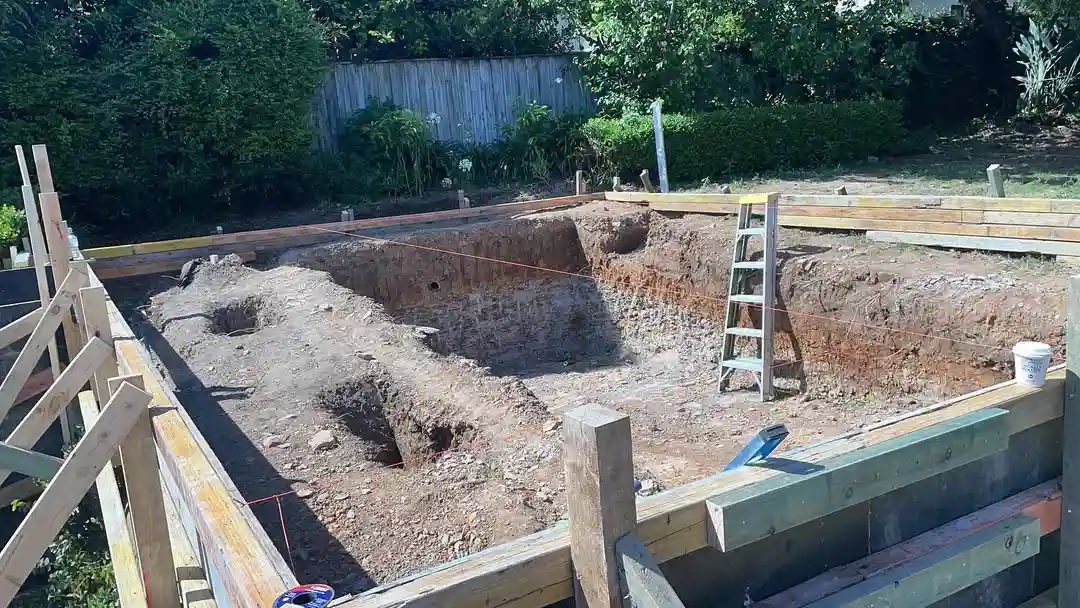
If you’ve had a soil test done for a house extension, a retaining wall, or even a new driveway anywhere between Penrith and Liverpool, there’s a decent chance the word “reactive” showed up on the report. Reactive clay is the single biggest ground-condition factor for pool builds across the Cumberland Plain, and it’s a completely different problem to the sandstone shelves that dominate excavation conversations closer to the harbour. If you haven’t already, it’s worth reading our breakdown of what’s actually under a typical Sydney backyard, because rock and clay call for almost opposite approaches to excavation and footing design.
This article covers what reactive clay pool excavation in Sydney’s western suburbs actually involves in practice: how the soil behaves, what your engineer will want to know before footings are designed, and what to ask a builder before you sign anything.
What makes clay "reactive," and why Western Sydney has so much of it
“Reactive” in a soils context has nothing to do with chemistry. It describes how much a soil’s volume changes as moisture moves through it. Some clays barely change between a wet winter and a dry summer. Others swell noticeably when saturated and shrink back hard enough to open visible cracks in the ground during a dry spell. That second kind is what engineers mean by reactive, or in more extreme cases, highly reactive or expansive soil.
Most of Western Sydney sits on the Cumberland Plain, a broad low-lying basin formed over Wianamatta shale. Shale breaks down into fine clay particles over geological time, and the result is deep clay profiles across huge parts of the region, in contrast to the Hawkesbury sandstone that dominates the closer-in and northern suburbs. That’s the short version of why an expansive soil pool site is far more common west of Parramatta than it is around, say, the northern beaches or the eastern suburbs, where excavation crews are usually fighting rock rather than moving clay.
None of this means a pool can’t be built. It means the ground behaves differently under load and moisture change than sandstone does, and the excavation and footing approach needs to account for that from the start rather than being an afterthought once the hole’s already open.
Reactive clay pool excavation Sydney: what actually happens during the dig
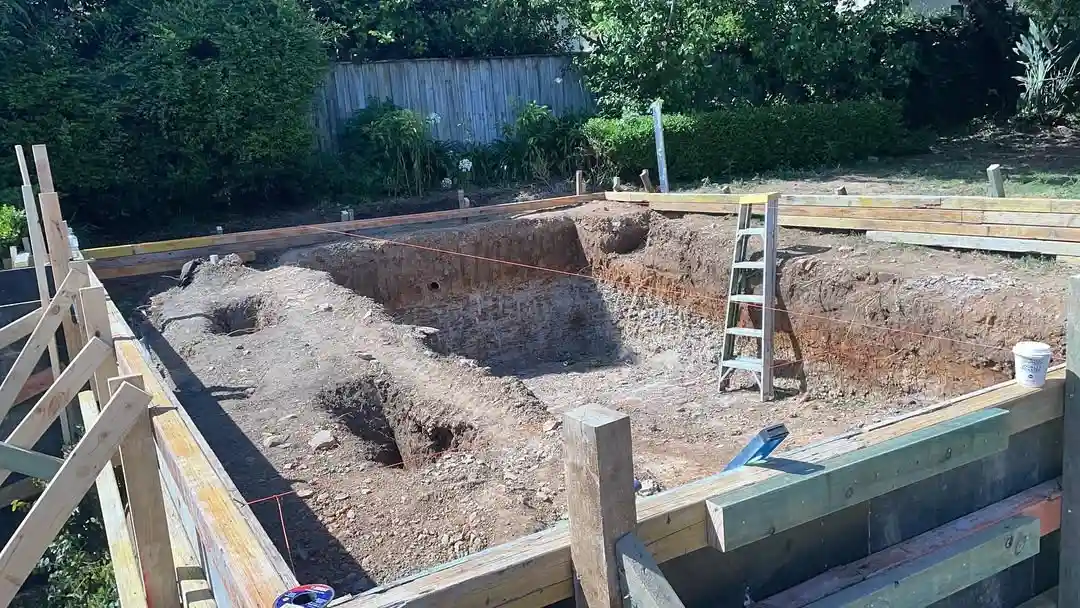
Digging through clay is, mechanically, usually easier than breaking through rock. An excavator moves clay quickly and there’s no need for rock breakers, which is one reason clay-site excavation can come in cheaper than a heavily sandstone-affected block. But easier digging doesn’t mean fewer things to manage. On a reactive clay site, the crew is watching for a different set of issues:
- Moisture at the time of the dig. Clay excavated wet behaves very differently to clay excavated dry, and can affect how stable the trench walls are while the shell, formwork and steel go in.
- How long the excavation stays open. The longer a clay excavation is exposed to sun, wind or rain before shotcrete goes on, the more the exposed clay face can dry, crack, or slump. Reactive clay sites are generally not ones you want to leave open for weeks.
- Groundwater and surface water management. Clay doesn’t drain the way sandy or rocky ground does, so water can pool at the base of an excavation rather than soaking away. Getting water off the site and away from the excavation edges is a bigger deal here than on a rock site.
- Batter angles and edge stability. Depending on depth and reactivity, the excavation walls may need to be cut back at a shallower angle, or supported, rather than dug near-vertical.
This is also where a genuine site-specific quote earns its keep. A generic per-cubic-metre rate that doesn’t account for how wet the site is, how deep the pool sits, or how the excavated clay is going to be handled and disposed of is a rough guide at best, not a number you should be locking in without a site visit.
Worth knowing: spoil (the clay dug out of the hole) from a reactive clay site is often unsuitable to reuse as structural backfill around the pool shell without proper compaction and drainage detailing. Ask upfront whether excavated clay is being removed from site or reused, and if reused, how it’s being placed and compacted. This is a common point where quotes quietly differ.
AS 2870 site classification and what it means for your pool
AS 2870 is the Australian Standard that governs residential slab and footing design based on how reactive the site’s soil is. Most Western Sydney homes already have an AS 2870 site classification on file from when they were built, ranging from Class A (barely reactive, low movement) through S, M, H1 and H2 (increasingly reactive) up to Class E (extremely reactive) and Class P (problem sites, often affected by fill, slope, mine subsidence or drainage issues rather than clay reactivity alone).
An AS 2870 site classification for a pool isn’t automatically the same as the one used for the house. The pool sits at a different depth, carries a different load profile, and is usually positioned somewhere else on the block, often closer to a boundary, a slope, or existing trees than the house footprint. A structural engineer will typically use available geotechnical information for the area, or commission a fresh test, to determine what footing and reinforcement approach the pool actually needs.
| AS 2870 Class | General reactivity | Typical implication for a pool site |
|---|---|---|
| A / S | Low to slight reactivity | Standard footing design in most cases; fewer special conditions |
| M | Moderate reactivity | Common across parts of Western Sydney; footing depth and reinforcement generally increased over Class A/S |
| H1 / H2 | High to very high reactivity | Deeper footings or piers often specified; drainage detailing becomes more important |
| E | Extremely reactive | More engineering input required; site-specific design rather than a generic approach |
| P | Problem site (fill, slope, drainage, etc.) | Needs individual geotechnical assessment; clay reactivity may be only one factor among several |
Treat this table as a general guide to the classification system, not a substitute for an actual site classification. Two blocks on the same street can come back with different classes depending on fill history, slope and drainage, which is exactly why a proper assessment matters more than a neighbour’s experience.
Clay soil swimming pool footings and structural design
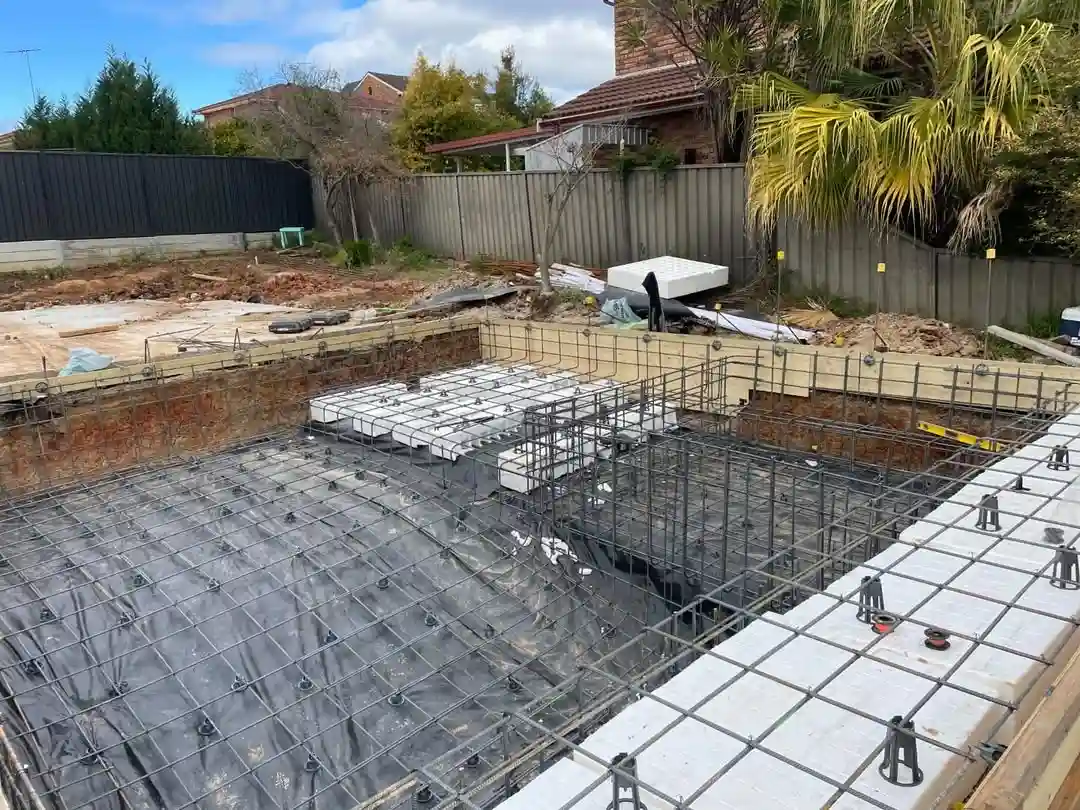
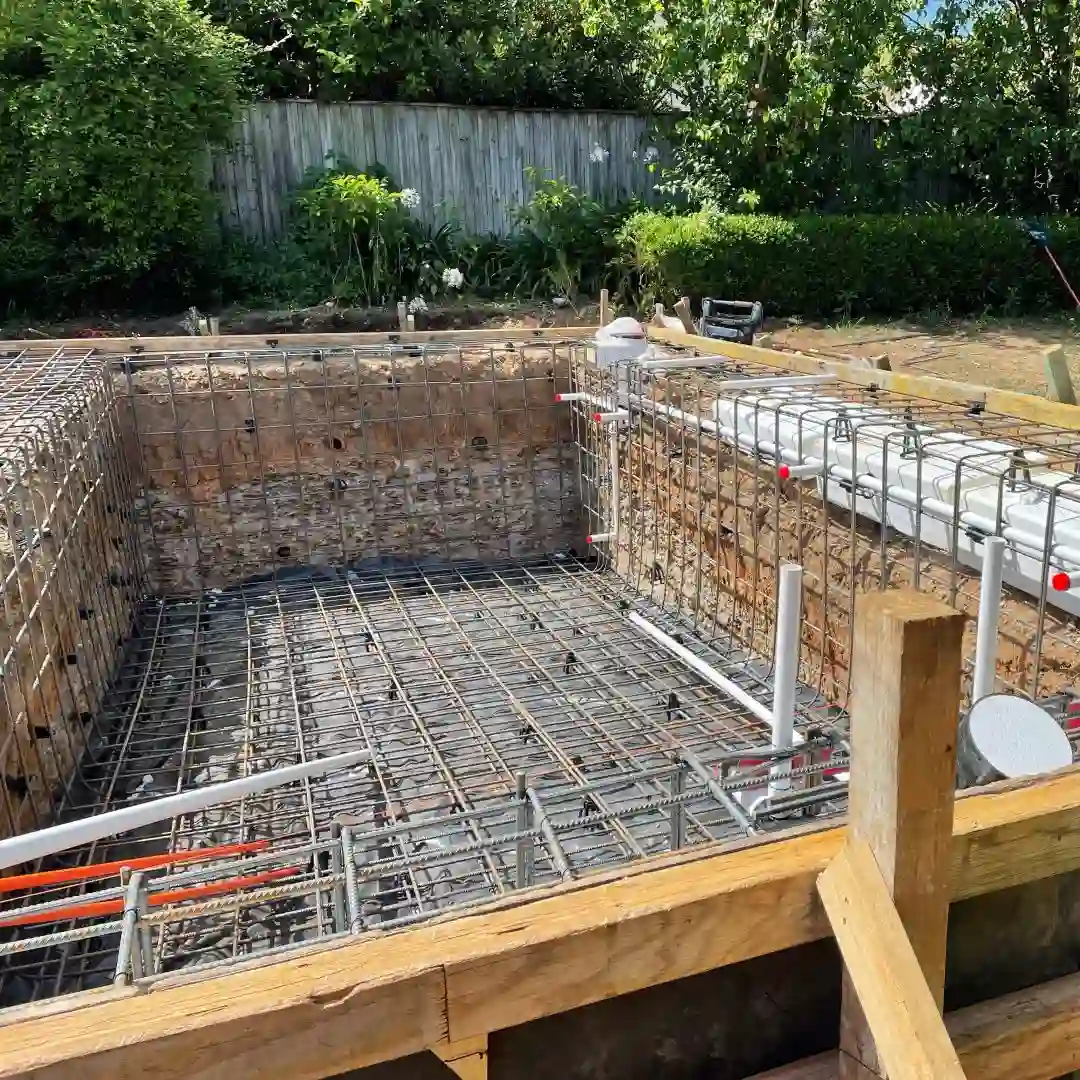
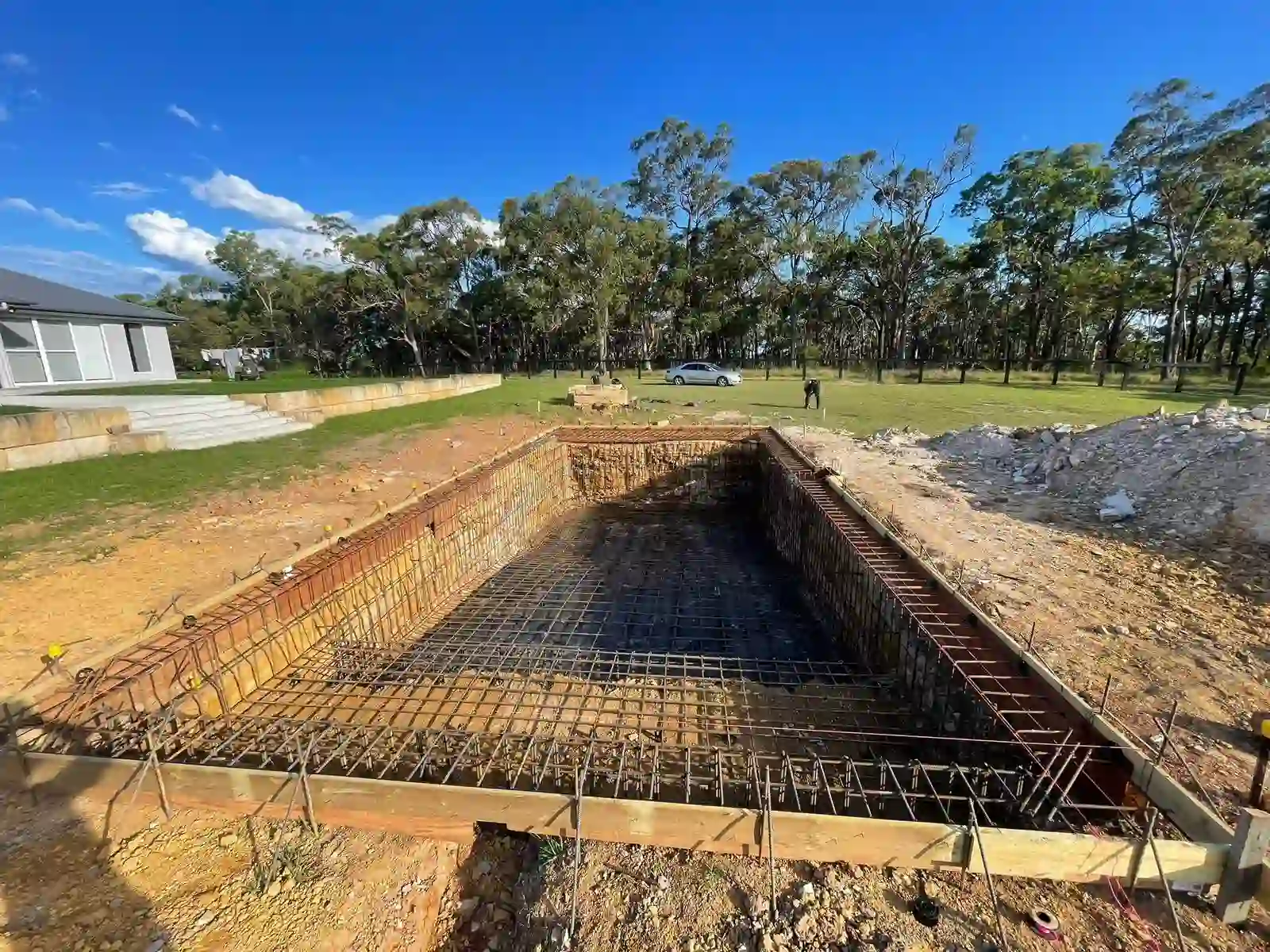
Once a site is classified, the engineer designs footings, and where needed, bored piers, to suit. On more reactive sites this can mean deeper edge beams, additional reinforcement, or piers that go down past the zone of the clay profile most affected by seasonal moisture change, so the shell is anchored below where most of the movement happens rather than sitting entirely within it.
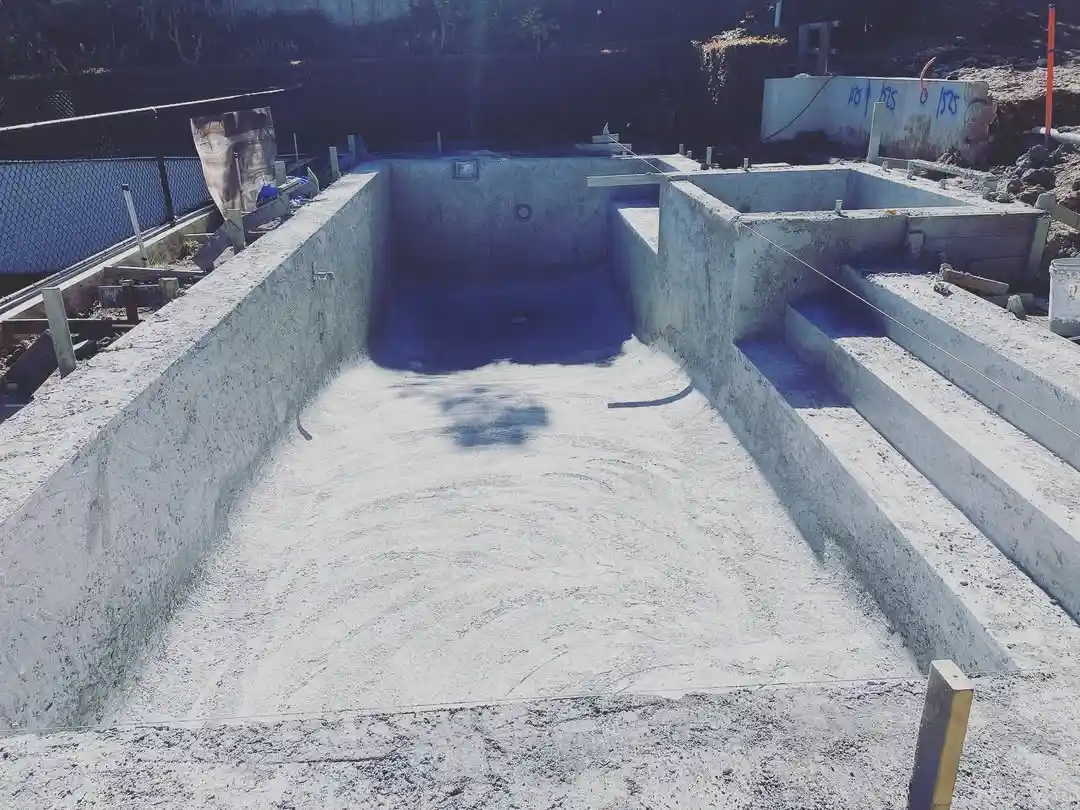
This is where excavation and structural work are really one connected process rather than separate jobs. Our pool excavation crew works from the approved engineering plans so the dig matches the footing design, not the other way around, and our formwork and steel fixing team ties the reinforcement in to the tolerances the engineer specified. Once that structure is in place, shotcrete locks the shell into its final shape and gives it the compressive strength to resist the pressures a reactive site can place on it over time.
A well-designed shell on a well-classified reactive site should handle normal seasonal clay movement without issue. Problems tend to trace back to one of a few causes: a footing design based on generic assumptions rather than an actual site classification, drainage that lets water pool against the shell or under a section of the site more than another, or a large tree planted (or removed) near the pool after construction, which changes how moisture is drawn from the clay around the roots. None of these are excavation faults exactly, but they’re worth understanding because they show why the ground assessment at the start matters as much as the concrete work later.
Where Cumberland Plain clay shows up: Penrith, Liverpool, Blacktown and beyond
Clay reactivity isn’t uniform even within Western Sydney, but the Cumberland Plain clay soil that underlies much of the region means pool excavation Western Sydney generally involves a different conversation to pool builds closer to the coast. In practice, we see moderately to highly reactive clay come up regularly on jobs across:
- Pool excavation Penrith and the surrounding areas, where shale-derived clay profiles are typically deep.
- Pool excavation Liverpool and nearby suburbs, another area sitting well within the Cumberland Plain basin.
- Pool excavation Blacktown, where clay conditions are common though individual blocks still vary with fill history and drainage.
- Surrounding suburbs across the broader Cumberland Plain, including parts of Fairfield, Campbelltown and the Hills district, where the same shale-clay geology extends.
The point isn’t that every block in these areas is automatically Class H2 or worse. Some aren’t. It’s that a builder quoting a pool anywhere in this belt without factoring in likely clay conditions, or without a site visit at all, is working on assumptions rather than your actual ground.
Red flags worth watching for in a clay-site quote
A few things are worth pushing on before you sign a contract on a clay-affected block:
- A quote with no mention of site classification or engineering input at all, especially if it was priced without anyone visiting the site.
- Vague language about “allowing for” difficult ground, without a clear number attached or an explanation of what triggers extra cost.
- No plan for what happens to excavated clay, particularly if there’s talk of reusing it as backfill without detail on compaction.
- No mention of drainage around the pool shell as part of the scope, since this matters more on clay than on rock.
Every site genuinely is different here, and that’s not a line to brush past. Reactive clay conditions vary from block to block and even across a single block, so figures in this article are general and indicative. Get your actual excavation scope, footing design basis, and how variations are handled, confirmed in writing before work starts.
FAQs
What is reactive clay and why does Western Sydney have so much of it?
Reactive clay is soil that changes volume noticeably as its moisture content changes, swelling when wet and shrinking when dry. Much of Western Sydney sits on the Cumberland Plain, a geological basin with deep shale-derived clay soils that are naturally more reactive than the sandstone-based ground found closer to the coast. Suburbs across the Penrith, Liverpool and Blacktown areas commonly report moderately to highly reactive clay.
Do I need an AS 2870 site classification before building a pool?
For the house, yes, an AS 2870 classification is standard practice and usually already exists from when the property was built. For a pool, your engineer will typically use geotechnical information (existing reports where available, or a fresh soil investigation) to classify the site and design footings and bracing to suit, since a pool shell behaves differently to a house slab and sits at a different depth in the clay profile.
Does reactive clay make pool excavation more expensive?
It can add cost, but usually less than rock does. The bigger cost driver with reactive clay is often engineering and footing design rather than the dig itself, plus extra care around dewatering, edge support and how long the excavation is left open. Every site is different, so treat any figure as general and confirm your actual excavation and footing scope in a written quote.
Can a pool still crack years later because of clay movement?
It’s possible if the original design didn’t properly account for the site’s reactivity, if drainage around the pool was poor, or if a large tree was planted or removed near the shell after construction. This is why footing design to the engineer’s specification, and proper drainage detailing during excavation and backfill, matter as much as the concrete work itself.
What should I ask my builder about clay conditions before signing a contract?
Ask whether the quote is based on an actual site inspection or a generic allowance, whether a geotechnical report or site classification has been obtained, how footings and any bored piers will be designed for the clay on your block, and what happens to the price if conditions differ once excavation starts. Get the answers in writing, not just a verbal assurance.
Got a Site in Sydney and Need a Straight Answer?
We’ll come out, look at your block, tell you honestly what’s achievable, and put a written quote in your hands within 24 hours. No obligation, no phone-quote guesswork.